
Through the Glass
On certainty, instinct, and what a six-year-old learns by watching his father.

February, 1996.
Chicago.
I was a community college student walking to zoology class through the gray cold of a Midwestern winter. The geese were everywhere, scattered across campus, moving through the courtyards and sidewalks with the confidence of creatures who have survived ice ages and empires.
I remember watching them.
Then I walked into class.
Our professor was out that day. In his place stood an older man with a white beard, bright eyes, and a vitality that filled the room before he spoke.
Some people study animals.
This man loved them.
You could feel it.
To him they were teachers disguised as birds. Philosophers wrapped in fur. He talked about migration and instinct the way other people talk about someone they admire.
Then he told us a story.
Earlier that morning he had been crossing the courtyard when he noticed a goose behaving strangely.
It was mating season.
The bird was charged, restless, alert.
Something old had taken hold of it.
It paced.
Watched.
Waited.
Then it spotted something, and it charged.
The fight exploded.
Honking.
Thrashing.
Wings beating.
It threw itself forward with a force that didn’t seem to belong to a bird.
Again.
And again.
And again.
Students stopped to watch. The sound rang across the courtyard. Feathers came loose in the cold air. And still the goose would not stop.
Eventually blood appeared at its mouth.
Enough.
Enough to show that whatever was happening had moved beyond survival into something else… something the bird could not stop even as it cost him.
He fought until he had nothing left.
And only then, emptied, bleeding, did he stop.
The bird froze.
The courtyard froze with it.
Its head tilted.
It moved.
The thing in front of it moved the same way, at the same instant, exactly.
It moved again.
Again the answer came back, perfect.
And then it looked.
Really looked.
There had never been another goose.
Only a window.
Only an image.
Only himself.
The old man let it sit.
Then he smiled.
“The goose didn’t gain insight,” he said, “until it got bloodied up.”
The class laughed.
I laughed too.
We took it for a joke, and it is a little funny… the pompous bird, the empty fight. But I have been turning that sentence over for thirty years, and somewhere along the way it stopped being funny.
Because look at what it actually says.
The goose did not stop when it understood.
It understood because it stopped.
And it did not stop because it grew wise.
It stopped because it ran out of blood.
Insight, in that sentence, is not a gift that arrives to spare us the fight. It is what remains after the fight has taken everything it was going to take.
The wound is the tuition.
You pay first.
You learn after.
There is no other order.
I have told this story for thirty years.
I tell it well.
I have told it at dinner tables and in rooms full of thoughtful people, and they go quiet in the right places, and I feel, telling it, like a man who has understood something.
That is the man I want to be.
Not only to be him. To be seen as him.
And even now, even in the writing of this, I can feel the small lean toward approval.
That pull is its own kind of charge.
And here is what I have to confess.
It has never once stopped me.
Every morning I reach for the glass before my feet touch the floor. And most days, something moves inside it… a slight, a comment, a person who is wrong on the internet, an argument I have already won a hundred times in the shower… and I charge it.
I throw my whole body in.
I am certain.
I am right.
But the certainty is a costume.
Underneath it I am as frightened as anyone.
And under the fear, when I am quiet enough to feel it, there is less of me down there than I spend all day defending.
The heat in my chest was never clarity.
It was fear, dressed as conviction.
I know it’s a window.
I have known it for thirty years.
Knowing has never been enough.
The recognition still comes only the way it came for the goose… late, after the blood, when certainty has finally burned itself out and I am standing there tired, holding an argument I can no longer remember the reason for, tilting my head at a face I should have known from the start.
It always arrives.
It always arrives after.
I used to call the goose my teacher.
A wise old bird who came back in my hardest moments to remind me to look closer.
And I built a life around looking closer.
Years of it.
Breath. Stillness. Chant. Meditate.
The mat in the dark before the house woke, certain that enough devotion would finally put distance between instinct and action.
It has not.
The goose never taught me anything I could use before I bled.
And neither did any of it.
None of it spared me the charge.
I don’t know what happened to the goose after it left the courtyard.
Whether it carried some new understanding back to the flock.
Whether it felt relieved.
Whether it felt foolish.
Whether by the next morning it had forgotten everything and charged the same window all over again.
I suspect that last possibility.
I suspect it because it feels familiar.
Thirty years later we stand before larger panes of glass.
They fit in our pockets.
They hang on our walls.
They glow beside our beds.
And every day something moves on the other side.
A stranger.
An opinion.
A fear.
A memory.
A version of ourselves.
And every day something ancient in us stiffens.
Narrows its gaze.
Prepares to charge.
I wish I could tell you that wisdom changes this.
That thirty years of devotion creates permanent distance between instinct and action.
It doesn’t.
There is the comforting version, where I see the lesson and am freed by it.
And there is the one I actually got.
The lesson is true, and it changes nothing about whether I’ll do it again.
What it changes is smaller.
The fight is shorter now.
The blood is less.
The head tilts a beat sooner.
That’s all.
That’s the whole of it.
I am still the goose.
I will always be the goose.
And there is a boy in my house who is learning that from me.
He is six.
He is learning what a man is the way all of us first learned it… by watching one.
And the man he is watching is the one who charges the glass.
That is the fear beneath all my other fears.
Not the enemies on the far side of the window.
What my son is taking in while I fight them.
That he will inherit the lunge. The certainty. The voice that rises to cover what it cannot feel.
I cannot give him a father who never charges.
That man does not exist.
But I can let him see the pause.
The tilt of the head.
The moment I catch my own reflection and do not break against it.
I can let him see me say I was wrong, and stay standing.
I used to believe strength was the charge.
I am trying to show him it is the stopping.
Some mornings I still wake and find the goose and the window waiting for each other.
But every now and then, before the collision, something else appears.
A pause.
A breath.
A flicker of recognition.
And in that small opening I catch sight of an old bird standing in a Chicago courtyard, staring into its own reflection.
For a moment we recognize each other.
Then one of us walks away.
And lately, when I turn, there is a boy watching me do it.
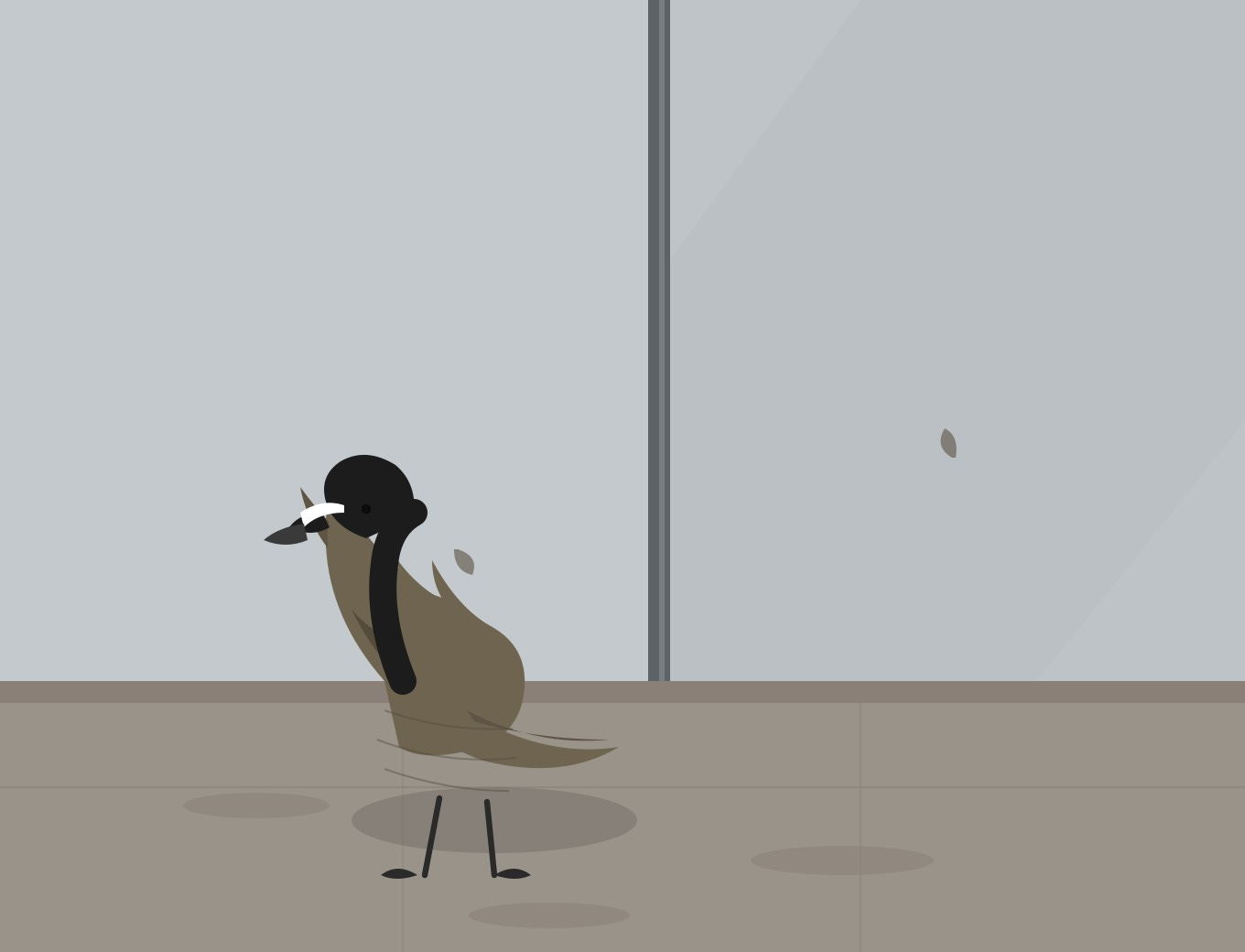
The empty fight.
Your son can, and will, see the pause before the fight before the fear takes over. This piece is inviting us not just into the pause, but into a deeper choice: integrity over fear.
That urge to charge is real. But we know it is not sustainable. It is not normal to live always ready to attack what we believe is a threat. If I charged at everything I thought was dangerous, trust me, I would be bloody and no good to myself or anyone else.
There is real freedom in the pause. There is power in asking what is underneath the trigger. Is it something new? Something old? Or something ancient passed down through generations?
And have I processed this wound in a way that is healthy and clean? Or is it still just dirty pain?